
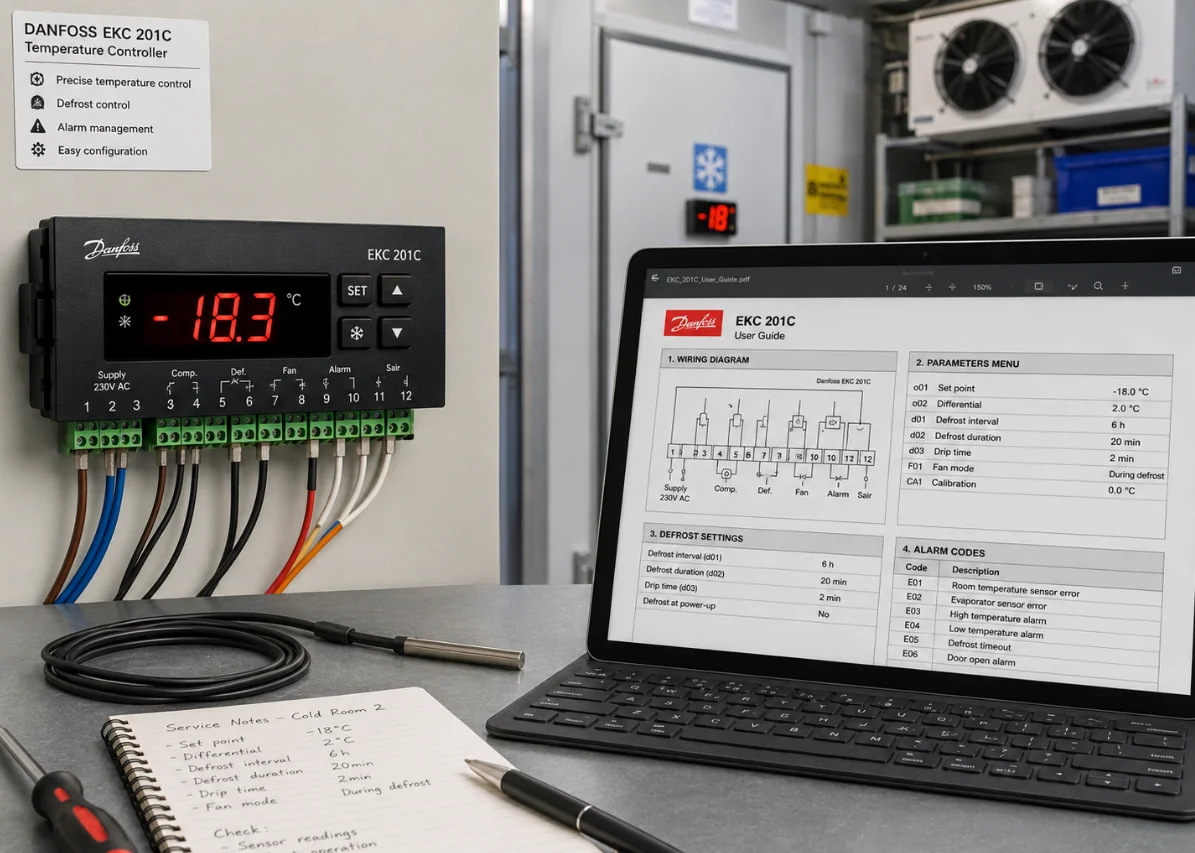
A refrigeration system depends on accurate temperature control. Whether the application is a display cabinet, cold room, refrigerated counter, storage unit, or commercial cooling installation, the controller is responsible for keeping the temperature within the expected range and helping the system operate reliably. A small mistake in wiring, sensor selection, parameter setup, defrost timing, or alarm configuration can affect product quality, energy use, compressor operation, and service reliability.
The Danfoss EKC 201C is a temperature controller designed for refrigeration applications. Like many professional HVAC and refrigeration components, it is not a device that should be configured by guesswork. The correct manual helps installers, service technicians, and maintenance teams understand how the controller should be connected, how parameters should be adjusted, how defrost management works, and how alarm messages should be interpreted.
The EKC 201C manual helps users check wiring, sensor configuration, thermostat settings, defrost parameters and alarm messages before servicing a refrigeration system.
Why the manual matters for a refrigeration controller
A temperature controller is a small component, but it has a large impact on the entire refrigeration system. It can influence compressor cycles, fan operation, defrost timing, alarm response, sensor readings, and display behavior. If the controller is configured incorrectly, the refrigeration system may still appear to run, but it may not maintain temperature accurately or may trigger unnecessary alarms.
This is why the manual should be treated as part of the installation process. It explains not only where wires should be connected, but also how the controller logic works. It helps the user understand which sensors are required, which parameters affect thermostat behavior, how the display is operated, and what the LED indicators mean. For technical equipment, reading the right section of the manual can prevent hours of unnecessary troubleshooting.
Start by confirming the exact model
Before applying any setting or wiring diagram, it is important to confirm the exact controller model. Danfoss produces many refrigeration and HVAC control products, and similar-looking controllers may have different terminals, parameter codes, sensor requirements, relay outputs, display functions, or communication options. A manual for a related model should not be used as a substitute unless compatibility is confirmed.
For this specific device, the Danfoss EKC 201C temperature controller manual is the correct place to check installation information, wiring diagrams, parameter settings, defrost configuration, alarm codes, sensor requirements, and technical specifications. Matching the document to the exact model helps reduce the risk of misconfiguration.
Installation and wiring: the foundation of reliable operation
Wiring is one of the most important parts of any refrigeration controller installation. A controller may have terminals for supply voltage, sensors, relay outputs, digital inputs, alarm output, fan control, defrost control, compressor control, and optional communication. If one connection is wrong, the controller may display incorrect temperature, fail to start defrost, trigger alarms, or control the refrigeration system incorrectly.
The EKC 201C manual should be used to identify the correct wiring layout before installation. Technicians should check the supply voltage, sensor inputs, relay ratings, load requirements, and connection diagrams. In refrigeration systems, wiring mistakes can be costly because they may lead to short cycling, compressor stress, missed defrost cycles, or incorrect cabinet temperature.
Work on electrical control systems should be carried out by qualified personnel. The manual can explain the connections, but it does not replace electrical competence, safe isolation procedures, or local regulations. Before wiring or servicing, power should be safely disconnected and verified according to proper procedures.
Sensor configuration and temperature accuracy
Temperature control depends on accurate sensor readings. If the wrong sensor type is selected, if the sensor is installed in the wrong location, or if the wiring is damaged, the controller may make decisions based on incorrect data. This can lead to unstable temperatures, unnecessary compressor operation, poor defrost performance, or alarms.
The manual helps users understand which sensors are required for the application and how the controller interprets them. It may include information about output sensors, input sensors, defrost sensors, and sensor type selection. When troubleshooting temperature problems, checking the physical sensor location and the controller parameter settings is often just as important as checking the refrigeration circuit itself.
Understanding the display and buttons
The front panel of a refrigeration controller is usually simple, but every symbol matters. A small display and a few buttons may be used to access menus, change parameters, view alarms, start manual defrost, or confirm settings. Users who do not understand the button sequence may accidentally change a value, fail to save a change, or misread an alarm message.
The manual should be used to learn how to access the parameter menu, navigate between codes, view values, change settings, and save adjustments. It is also useful to understand the LED indicators. LEDs can show refrigeration operation, fan activity, defrost status, or alarm conditions. When a system behaves unexpectedly, these indicators are often the first clue.
Thermostat settings and differential control
The thermostat function is central to the controller. The setpoint determines the desired temperature, while the differential controls how the system responds around that setpoint. If the differential is too narrow, the compressor may cycle too frequently. If it is too wide, the temperature may fluctuate more than desired. The right setting depends on the application, product sensitivity, cabinet design, airflow, sensor placement, and system capacity.
This is one of the areas where a manual is useful, but professional judgment is also important. The manual explains what each parameter does, while the installer or technician must decide which values are suitable for the actual refrigeration system. A display case holding temperature-sensitive products may require different settings than a general storage cabinet.
Defrost management: why correct settings matter
Defrost control is one of the most important functions in many refrigeration systems. Ice buildup on the evaporator can reduce airflow, lower cooling efficiency, increase energy use, and eventually prevent the system from maintaining temperature. On the other hand, too much defrost can waste energy, warm the cabinet unnecessarily, and affect stored products.
The EKC 201C manual helps users understand defrost interval, duration, sensor-based termination, manual defrost, coordinated defrost, and display behavior during defrost. These settings should not be changed randomly. If defrost is not starting, ending too early, lasting too long, or causing temperature alarms, the manual provides a structured way to check the relevant parameters.
Coordinated defrost in multiple-controller systems
In some refrigeration installations, several controllers may need to coordinate defrost cycles. This can be important in larger display systems or multi-section refrigeration equipment. If controllers defrost at different times without coordination, airflow, temperature distribution, and system load may become less predictable.
The manual can help identify whether coordinated defrost is supported and how it should be configured. Depending on the installation, coordination may require wiring, communication modules, or specific parameter settings. This is an area where careful documentation is essential, because future service technicians need to understand how the system was originally configured.
Alarm troubleshooting and error codes
Alarm messages are not just warnings to clear and ignore. They are diagnostic signals that help identify what the controller is seeing. An alarm may indicate a controller fault, sensor problem, door alarm, defrost sensor issue, input sensor issue, output sensor issue, or another condition that needs attention.
A good troubleshooting process starts with reading the displayed code and checking the manual. For example, sensor-related alarms may require checking whether the sensor is connected, short-circuited, disconnected, damaged, or configured incorrectly. A door alarm may require checking the digital input, door switch, delay setting, or cabinet condition. Clearing an alarm without understanding the cause can allow the same problem to return.
Factory reset and parameter documentation
In some cases, returning a controller to factory settings may be useful, especially when the previous configuration is unknown. However, a reset should not be used casually. After a reset, important parameters may need to be configured again, including thermostat settings, sensor type, alarm delays, defrost values, compressor timing, fan settings, and display behavior.
Before changing parameters or performing a reset, it is good practice to record the current settings. A simple parameter sheet can save a lot of time later. In commercial refrigeration, documentation is part of good maintenance practice. It helps future technicians understand what was changed, why it was changed, and how the system was intended to operate.
Technical specifications in practical use
The technical data section should not be skipped. It may include supply voltage, sensor compatibility, measuring range, enclosure protection, relay ratings, power consumption, ambient conditions, and other limits. These details determine whether the controller is suitable for the application and whether the connected loads are within allowable limits.
For example, relay ratings matter when controlling compressors, fans, alarms, and defrost heaters. Sensor compatibility matters when replacing a probe. Supply voltage matters when diagnosing a controller that does not power up. Measuring range matters when evaluating whether the controller is suitable for a particular cooling application. Technical specifications are not just numbers; they are practical limits.
Where to find related Danfoss documentation
Danfoss manufactures many products for heating, cooling, refrigeration, pressure control, valves, pumps, motor control, and industrial automation. If you need documentation for another model, the Danfoss manuals category is a useful place to look for related PDF guides. This is helpful when servicing systems that include multiple Danfoss components, such as controllers, valves, pressure switches, communication modules, or pumps.
When browsing related manuals, always confirm the exact product and model before applying instructions. Similar devices may have different wiring diagrams, parameter codes, safety requirements, or service procedures. In technical installations, using the wrong manual can lead to incorrect conclusions.
Best practices for technicians and maintenance teams
A practical approach to using the EKC 201C manual is to keep it available during installation, commissioning, and service. During installation, use it for wiring and sensor setup. During commissioning, use it for parameters, setpoints, differential values, defrost settings, and alarm delays. During troubleshooting, use it for error codes, LED behavior, sensor checks, and reset procedures.
Maintenance teams should also keep a record of final parameter values. If a controller is replaced, the recorded values can help restore operation quickly. If a refrigeration system has recurring alarms, comparing actual settings with documented settings can reveal accidental changes or incorrect adjustments.
Final thoughts
The Danfoss EKC 201C temperature controller plays an important role in refrigeration control, but its reliability depends on correct installation, sensor configuration, parameter setup, defrost management, and alarm interpretation. The manual provides the structure needed to work through those tasks safely and logically. For installers, service technicians, and maintenance teams, reading the right sections of the PDF is not a formality. It is a practical way to reduce errors, improve diagnostics, and support stable refrigeration operation.
Leave a Reply